

The question of whether manual or automated quality assurance (QA) testing is beneficial to your enterprise is an important one. But it is not as black and white as it may seem. It is not about replacing testers with tools but a decision about where human judgment adds value and where repeatable testing needs speed, scale, and consistency.
For enterprises running ERP, web applications, APIs, and integrated business workflows, this distinction matters. A delayed regression cycle can hold up a release. A missed defect in finance, manufacturing, supply chain, or CRM can interrupt operations. The practical question is not “manual or automated?” It is, “What should remain manual and what should be automated first?”
What is manual vs. automated QA testing?
Manual vs. automated QA testing are two ways of validating software. While manual QA relies on testers executing test cases by hand, automated QA testing uses scripts, tools, and platforms to run repeatable tests automatically.
Manual testing is performed step by step by a human tester, requiring human observation, judgment, and adaptability. On the other hand, automated QA testing is executed programmatically using tools and frameworks and is best suitable for stable, repeatable, high-volume test cases where speed and consistency matter.
In enterprise environments, the strongest use case for automated QA testing is usually automated regression testing, checking whether existing processes still work after an update, release, configuration change, integration change, or system upgrade.
Why do enterprises still need manual QA testing?
As important as automated testing is, enterprises still need manual QA testing because not every test can or should be automated. In certain scenarios, such as evaluating new features, unusual instances, usability issues, and business context, human testers are better.
Manual QA testing is useful when:
- A process is new and still changing
- The team is exploring unknown defects
- User experience needs human judgment
- A test case is executed rarely
- The scenario is too complex or unstable to automate immediately
While manual testing is adaptable because testers can adjust their approach as they uncover issues, it is also more time-consuming and more prone to inconsistent results than automation.
Therefore, finding the right balance between manual vs. automated QA testing is important. Teams should not be pressured to automate for the sake of automation as poor automation can result in maintenance debt.
When does automated QA testing become the better choice?
| Testing scenario | Better fit | Why |
|---|---|---|
| Exploratory testing | Manual QA testing | Requires judgment and discovery |
| Usability validation | Manual QA testing | Human experience matters |
| ERP regression testing | Automated QA testing | Repeatable and business-critical |
| API contract checks | Automated QA testing | Needs speed and consistency |
| Cross-system workflows | Automated QA testing | Reduces missed integration defects |
| One-off test cases | Manual QA testing | Automation may not pay back |
What are the risks of solely relying on manual regression testing?
The biggest risks of manual regression testing are slow release cycles, missed defects, inconsistent execution, limited coverage, and overdependence on scarce business users or SMEs.
These risks grow as systems become more connected. A manufacturer, for example, may need to validate order capture, production planning, inventory updates, shipment, invoicing, and finance posting as one end-to-end flow. In fashion or food and beverage, seasonal demand, compliance, and supply chain volatility make delays even more expensive.
ERP releases, CloudSuite updates, on-premise upgrades, OS upgrades, and custom developments all need structured regression testing to confirm that core workflows remain stable and perform as expected.
Can automated QA testing replace manual testing?
Automated QA testing cannot completely replace manual testing. The strongest enterprise QA model is hybrid: automate repeatable regression tests and keep manual testers focused on judgment-led validation.
The mistake is trying to automate everything at once. A hybrid model can look like:
- Exploratory testing, UX validation, new process walkthroughs, exception handling, and early-stage features to be kept manual.
- Stable regression suites, smoke tests, API checks, cross-platform validations, release readiness checks, and high-volume test cases to be automated.
What should enterprises automate first?
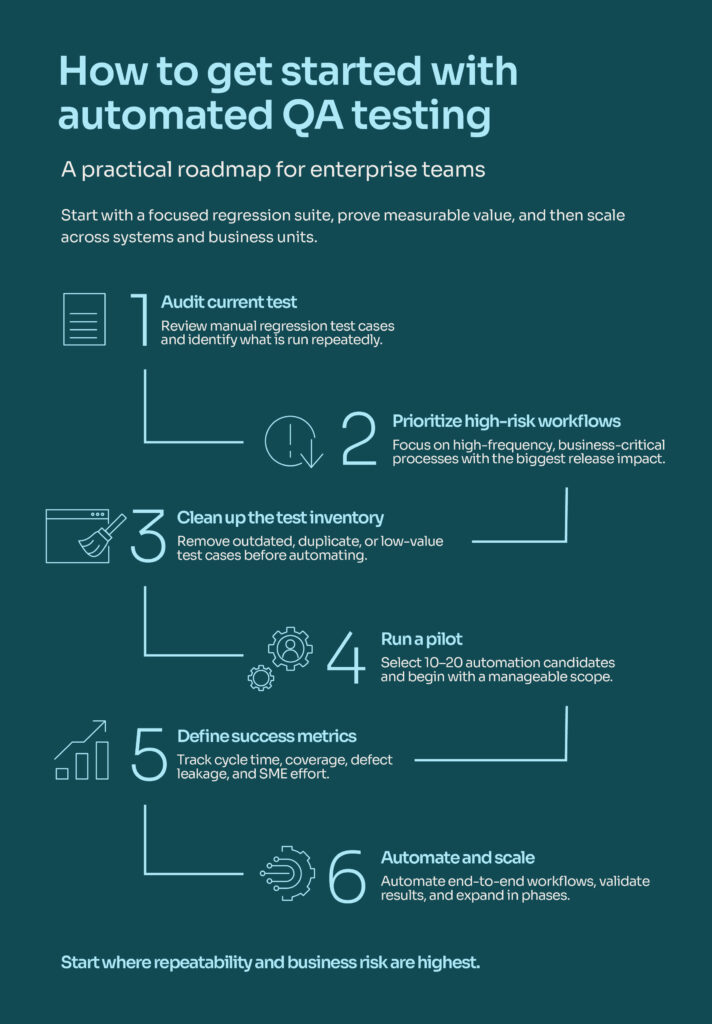
Enterprises should automate business-critical regression tests first, especially workflows that are repeated often, involve multiple systems, and create high operational impact when they fail.
Start with processes such as:
- Order-to-cash
- Procure-to-pay
- Record-to-report
- Plan-to-produce
- Inventory and warehouse movements
- Pricing, promotions, and invoicing
- ERP-to-ecommerce flows
- ERP-to-CRM workflows
- API and integration checks
This is where Fortest – our AI-powered automated regression testing product , fits naturally. Fortest supports end-to-end process validation across ERP, web, APIs, and third-party integrations, and provides centralized test management for scripts, plans, reporting, execution pipelines, and release readiness.
Fortest also includes AI workflow recording and script generation, AI-driven self-healing, synthetic test data, secure credential management, and cloud/on-premise support. These capabilities are especially useful because one of the common objections to automated QA testing is to reduce maintenance effort.
Is AI changing manual vs. automated QA testing?
Move faster with a smarter QA strategy
Manual vs. automated QA testing is not about choosing one over the other. It is about using manual QA where human judgment matters and automated QA testing where speed, repeatability, and consistency protect the business.
For enterprises running complex ERP and integrated systems, automated regression testing is usually the right place to start. Fortest helps teams automate critical workflows, reduce regression testing effort, improve release confidence, and free SMEs from repetitive validation.
Ready to reduce regression testing risk? Book a Fortest demo or speak to us about assessing your automation-ready test cases.